Caiaphas and the Crucifixion of a Phantasm | Week 2 of Summer Curriculum
This week’s reading:
Dante, Inferno — Cantos XIV–XXVI
Augustine, Confessions — Books IV–V
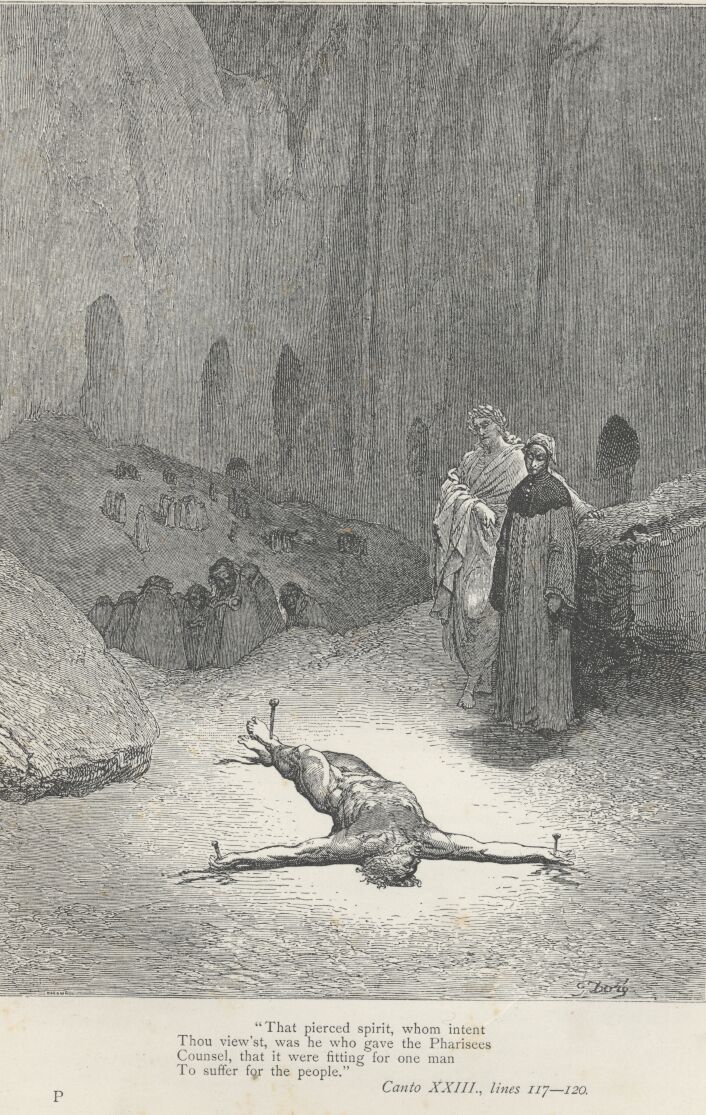
This week I greet you with an image so ominous. Behold Caiaphas’s fate. Little pity can be found for Caiaphas, whose punishment mirrors his own judgment. He is sentenced to a torment most fitting for his sin: destined to lie face up upon cold sod, trampled by hypocrites for ages.
“O friars!” I began, “your miseries—”
But there brake off, for one had caught my eye,
Fix’d to a cross with three stakes on the ground:
He, when he saw me, writh’d himself throughout,
Distorted, ruffling with deep sighs his beard.
And Catalano, who thereof was ‘ware
Thus spake: “That pierced spirit, whom intent
Thou view’st, was he who gave the Pharisees
Counsel, that it were fitting for one man
To suffer for the people.” (Dante, Inferno XXIII.115–123; cf. John 11:49–50)
Caiaphas’s punishment is fitting not only because he condemned Christ to the cross, but because his judgment itself was formed by a false vision of reality. He saw only the appearance of a political threat, not the incarnate Word standing before him.
Caiaphas did not merely hate Christ; he failed to recognize Him. He saw a king who threatened earthly order rather than the King whose kingdom is not of this world. His tragedy is that he acted according to a distorted perception of what was real.
This pattern is echoed in the Manichees of Augustine’s early life. They taught that Christ did not truly take on flesh, nor truly suffer, but that the crucifixion was only an appearance—a phantasma. In both cases, the truth of Christ is reduced: for Caiaphas, to a dangerous man to be eliminated; for the Manichees, to a divine figure who only seemed to suffer.
“…I was going down to hell, carrying all the sins which I had committed, both against Thee, and myself, and others, many and grievous, over and above that bond of original sin, whereby we all die in Adam. For Thou hadst not forgiven me any of these things in Christ, nor had He abolished by His Cross the enmity which by my sins I had incurred with Thee. For how should He, by the crucifixion of a phantasm, which I believed Him to be?” (Augustine, Confessions V.10).
In his youth, Augustine sought refuge among the Manichees, yet found their doctrine itself to be a phantasm. Burdened by sin, he lost all hope: for how could Christ forgive him if Christ were not truly flesh, not truly suffering, not truly present?
Even today, people reduce God to an image they can control. Some fashion a god who blesses without judgment. Others deny God altogether, leaving only an abstraction or projection of human desire.
Caiaphas judges Christ as a phantom; the Manichees deny His true humanity by making Him a phantom. Augustine is brought to see that only the true Christ—fleshly, suffering, and risen—can dissolve every phantom by the weight of reality itself.
Back to Home →