Analysis on Our Lord Has Laid His Benison
This week’s readings:
Dante, Purgatorio — Cantos I–XIII
Augustine, Confessions — Books X–XIII
I take a break this week from my usual writings on the Confessions and Divine Comedy to speak on this hymn by Martin Franzmann. This busy week was capped off by an even busier weekend. I attended a conference celebrating the launch of a timeless addition to Lutheran hymnbooks: Te Laudamus.
Te Laudamus is as much a book of practicality as it is a work of art—a timeless tome of Lutheran hymnody. The fonts, the music, the art, and the cover envelope a rich selection of hymns. There is not a page wasted. The music is engraved so that it serves the words; the music does not take priority over the confession the words make.
Contained within this volume are all of Martin Luther’s hymns, Franzmann’s hymns, all of the Psalms (taking care that even those deemed imprecatory are not left out), and many more treasures of the Lutheran tradition.
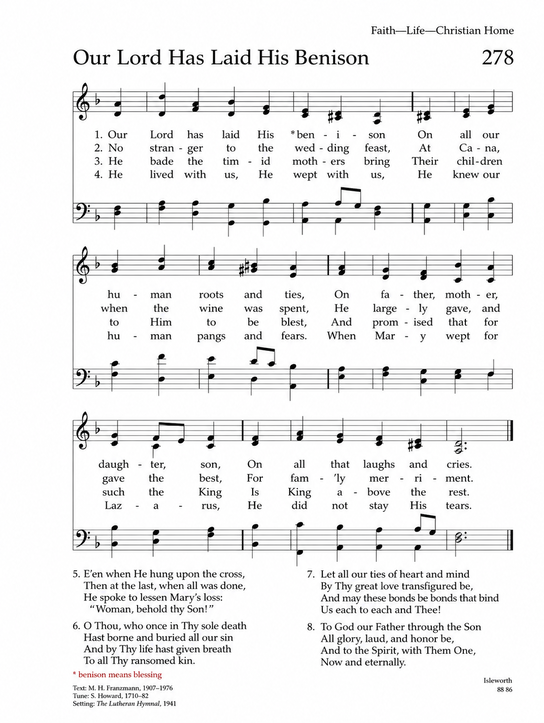
One Franzmann hymn that particularly caught my attention was Our Lord Has Laid His Benison (Te Laudamus 278). Therefore, I devote this article to an analysis of this hymn.
Our Lord has laid His benison
On all our human roots and ties,
On father, mother, daughter, son,
On all that laughs and cries.
No stranger to the wedding feast,
At Cana, when the wine was spent,
He largely gave, and gave the best
For fam’ly merriment.
NB: “Benison” means blessing.
In these first two stanzas, Franzmann begins not at the cross, but at Christ’s becoming man. Franzmann emphasizes the “human roots and ties,” showing that Jesus had a mother and father, He entered ordinary family life, and He shared our human relationships. “And He went down with them and came to Nazareth and was submissive to them.” (Luke 2:51a)
God sought not to save humanity by ignoring human existence, but rather sent His only-begotten Son. The incarnation sanctifies human life.
He bade the timid mothers bring
Their children to Him to be blest,
And promised that for such the King
Is King above the rest.
He lived with us, He wept with us,
He knew our human pangs and fears.
When Mary wept for Lazarus,
He did not stay His tears.
These next stanzas move through Christ’s life and show how He bears human joys and sorrows.
These stanzas allude to two very common Bible stories: Jesus blessing the children in Mark 10 and Jesus weeping at Lazarus’s tomb in John 11. Franzmann reminds us that Christ is a Savior who truly knows human grief.
E’en when He hung upon the cross,
Then at the last, when all was done,
He spoke to lessen Mary’s loss:
“Woman, behold thy Son!”
O Thou, who once in Thy sole death
Hast borne and buried all our sin
And by Thy life hast given breath
To all Thy ransomed kin.
In these stanzas, we see Christ hanging upon the cross, and Franzmann paints us a portrait of a mother’s grief. The greatest blessing comes through Christ’s suffering and death.
The same Christ who blesses children is the Christ who bears sin. “Christ redeemed us from the curse of the law by becoming a curse for us—for it is written, ‘Cursed is everyone who is hanged on a tree.’” (Galatians 3:13)
The “benison” comes through the cross.
Let all our ties of heart and mind
By Thy great love transfigured be,
And may these bonds be bonds that bind
Us each to each and Thee!
To God our Father through the Son
All glory, laud, and honor be,
And to the Spirit, with Them One,
Now and eternally.
In these final two stanzas, Franzmann moves outward. The hymn draws to its conclusion by showing how Christ’s blessing transforms not only individual lives but also the relationships between believers. Christ’s love binds His people together, and all glory returns to the Trinity.
The final eighth stanza forms a glorious doxology. The hymn has a certain Ambrosian air about it: like many of the ancient hymns attributed to St. Ambrose, it consists of eight stanzas, moving from confession into praise. The number eight also carries a deeper biblical resonance. As eight souls were saved through water in the ark, so Christ brings His people through the waters of death into the new creation.
The hymn begins with Christ entering into a human family and ends with humanity gathered into the family of God. The blessing Christ lays upon humanity is not merely a blessing of earthly life, but the eternal blessing won through His incarnation, death, and resurrection.
Written on June 28, 2026. All Scripture references from ESV.
Interested in getting a copy of Te Laudamus? Get yours at telaudamus.org.
Back to Home →